Many companies and businesses that want to rank well in search engines or AI programs implement a series of SEO actions to improve the ranking of their websites or online stores. However, among these actions are some controversial techniques, such as the creation of external links, which are highly regulated in the industry (especially the buying and selling of links for ranking purposes). In this article, we will learn about the various Google rules regarding the buying and selling of external links.
Link Spam
Google’s web search spam policies (specifically the link spam section) contain all the rules related to buying and selling links, as well as the different criteria Google applies to determine the legality of each action.
Buying and Selling Links for SEO Purposes
The rule clearly states that buying and selling links for search engine optimization purposes is a 100% prohibited activity. However, the rule not only prohibits financial transactions (sending or receiving payment to obtain a link) but also covers other aspects, such as incentives, gifts, and terms of service.
Incentives and Gifts
The rule states that gifts or incentives cannot be received in exchange for placing a link for ranking purposes. An example of this would be a company sending a free product to someone in exchange for a review and a link on their website.
Part of the Terms of Service
The rule also states that it is prohibited for a company or business to “force” a customer to include a link to its website, especially when this is part of the terms and conditions of the service it offers.
Excessive Link Exchange
The rule states that some websites “exchange links,” and that this activity is valid and not penalized. However, when the system detects many of these link exchanges, Google will penalize the websites involved for link spam (specifically for excessive link exchange).
Automated Programs
The rule prohibits the use of automated programs or software to create external links. It also prohibits the use of automated programs or services to create links that lead to our website or online store. Unfortunately, due to the popularity of artificial intelligence programs, their misuse to create external links has increased considerably, making it one of the most frequent violations.

Sponsored Articles
The rule addresses sponsored articles. It states that editorial advertisements or native advertising, where payment is received for articles that include links that improve search engine ranking, or for links with optimized link text in articles, guest posts, or press releases distributed on other sites, are prohibited.
It states that while someone can publish an article on a blog as a guest author/writer, the problem lies with the links published. For example, if the author’s website URL appears at the end of the article, then that link is valid. However, if there are links (with keywords) within the text, or if the author’s URL is linked to a keyword, those links will be considered illegal, as they are used for search engine optimization (SEO). Here’s an example:
Permitted author’s byline:
Jose Luis Moreno Jimenez
Illegal author’s byline:
Jose Luis Moreno Jimenez
Footer
The rule states that links in the footer are prohibited. Unfortunately, this is another widespread bad practice in the industry, commonly used by some web designers or developers who place their website link in the footer of their clients’ online stores or websites.
Optimized Comments
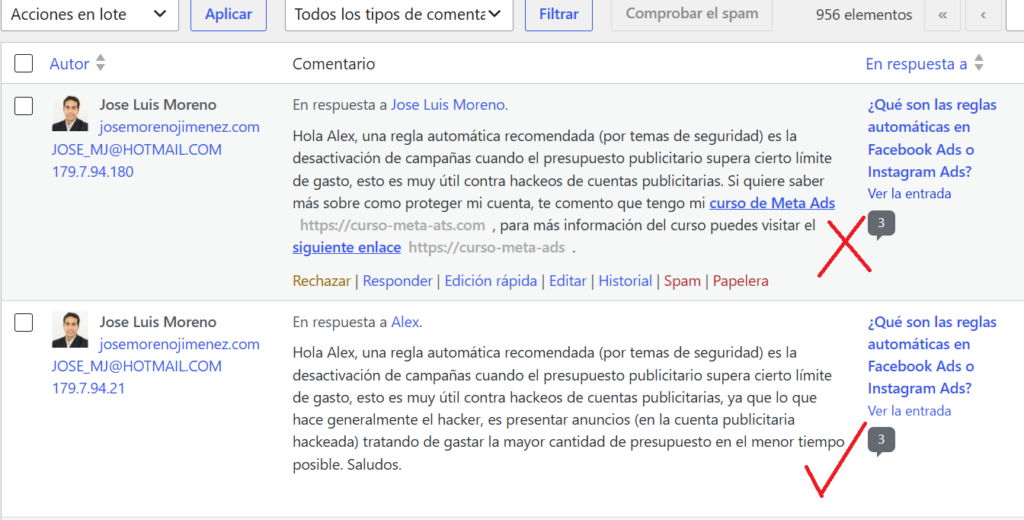
The rule states that comments are allowed, as long as they don’t contain URLs for SEO purposes or aren’t optimized for search engines. For example, comments can be posted on a WordPress blog post; however, there’s a clear difference between a comment that includes a link with a keyword (optimized for SEO and frowned upon by Google) and a “natural” comment without links in the body of the text (approved by Google). It’s important to note that WordPress comments have a special field for adding a link (which usually appears below the author’s name), and it’s not recommended to include links within the comment body.
Exceptions to the Rule
It’s important to note that there are some exceptions to the rule. For example, it states that buying and selling links for advertising or sponsorship purposes is authorized, provided they include the corresponding “do not follow” or “sponsored” tags.
The nofollow tag (rel=”nofollow”) means it should be ignored by search engines and does not transfer SEO authority.
The sponsored tag (rel=”sponsored”) indicates commercial activity unrelated to search engine optimization, such as branding, banner advertising, or advertising to generate direct clicks.
Google’s ability to detect external links: It’s important to note that Google has many ways of detecting when a website is buying links for SEO purposes. For example, a website with 50,000 monthly organic search traffic will naturally generate 4-5 external links per month. However, a website with only 500 monthly organic search traffic will be highly suspicious if it suddenly starts generating 10 links per month, especially consistently and from a specific date.
Criteria for choosing an SEO agency: External link building is a good way to evaluate an agency’s or a professional’s professionalism. If you’re getting quotes for SEO services that include external link building, it should raise a red flag. This activity is heavily regulated by Google, and external link building is the “final” step in any SEO project and should only be done when absolutely necessary. For example, if a website has professionally worked on the various SEO pillars for several years and has improved its rankings, but can’t seem to climb above a certain specific position (for example, it can’t get past position 3), then, in that very specific case, the possibility of creating external links can be considered.
Personal and professional advice on the subject: In my experience, external link building is the second most common reason websites are penalized. I personally don’t recommend creating external links. Instead, it’s better to focus on the different SEO pillars, such as page load times, navigation, website architecture, structure, user experience, internal link building, content creation, and compliance with SEO guidelines, among others. Only after all the pillars of SEO have been professionally developed over several months can we truly consider building external links. Ultimately, we must remember that the best external links for our website are natural links, but for this to happen, our website must be relevant in its industry.
Video
In the following video, I briefly explain the main points:
What are your thoughts on this topic? Are you familiar with any other Google guidelines regarding buying and selling links?
If you’d like to learn more about SEO, I recommend my WordPress SEO course for businesses and service providers. For more information about the course, including the syllabus and student testimonials, please visit the following link.