Currently, many companies and businesses want to learn about TikTok’s rules, especially to comply with them when contacting potential customers. However, instead of consulting the original sources (TikTok’s rules) or qualified professionals, many people use AI programs (like ChatGPT) to verify the legality of an action, which can be counterproductive, as we will see below. To illustrate this point, I will use the example of the “supposed” 48-hour response time rule on TikTok. This rule states that if we send a message to a potential customer (in an ongoing conversation) and they don’t reply, we can send them another message (even if they haven’t responded to the previous one), as long as no more than 48 hours have passed.
Standard Question in ChatGPT (Example)
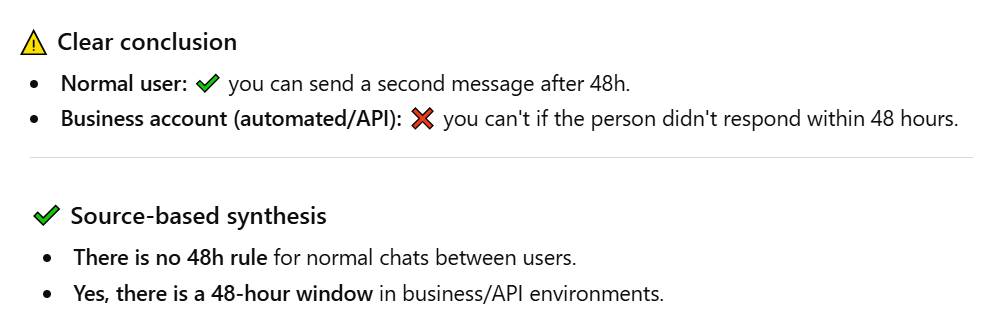
In this example, the user asks ChatGPT a simple question: Can you send a second message on TikTok after 48 hours if the person hasn’t replied? ChatGPT’s response is roughly as follows:
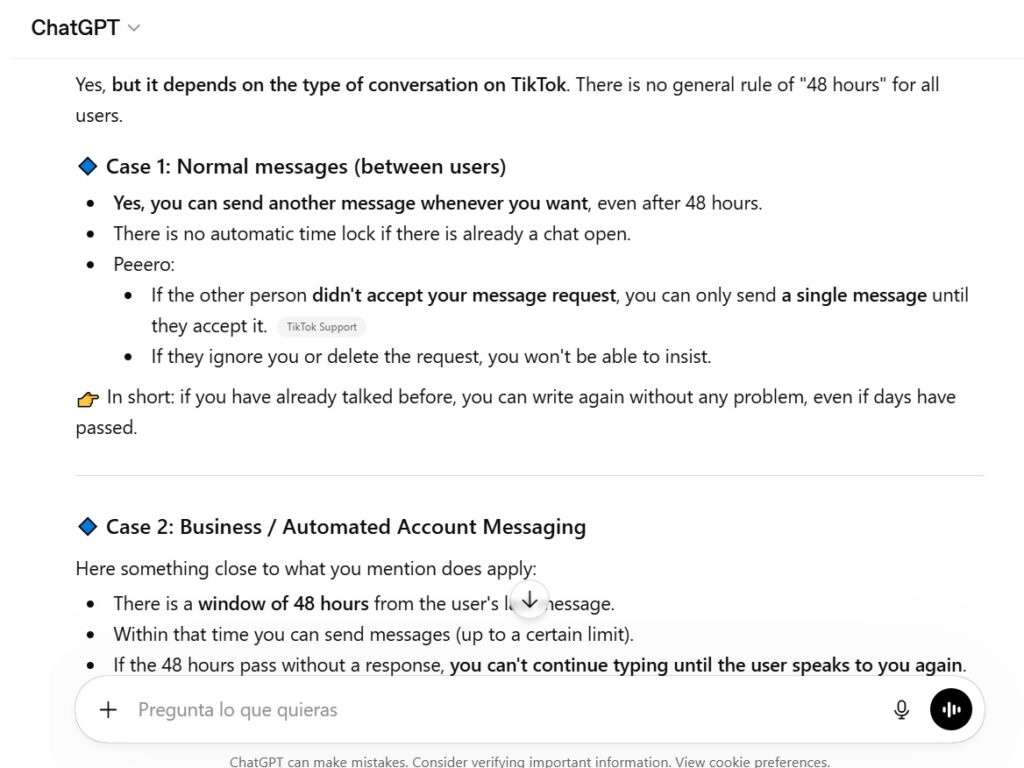
As we can see, the answer is yes, and two scenarios are mentioned: one involving regular users (with regular messages and the first message from an unknown person) and another involving messaging from business accounts. However, we can see some inconsistencies in the sources cited in ChatGPT’s response:
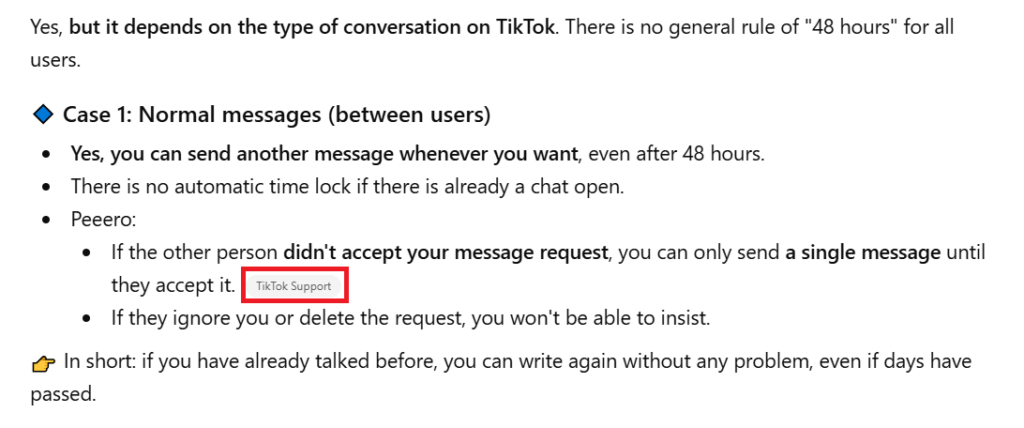
In the first response or case, TikTok support is cited, but the original link is support.tiktok.com/using-tiktok/messaging-and-notifications/direct-message-settings. However, this URL redirects to tiktok.com/support/faq_detail?id=7543897463967734277. This means that at some point, this URL was valid, but then, when the policy was updated, it changed to a new URL (and the old URL was redirected). This demonstrates that the policy was modified or updated at some point, and that the cited URL may correspond to an earlier version or simply an outdated policy.
When we reviewed the source, we realized that while it is a TikTok page, it’s not a page about the rules, but rather a page that explains (in very general terms) what TikTok private messages are, mentioning that the “Community Guidelines” offer guidance on what is and isn’t allowed on TikTok.
Then, in the second response or case, TikTok isn’t cited; instead, an external website called respond.io (a CRM) is cited.
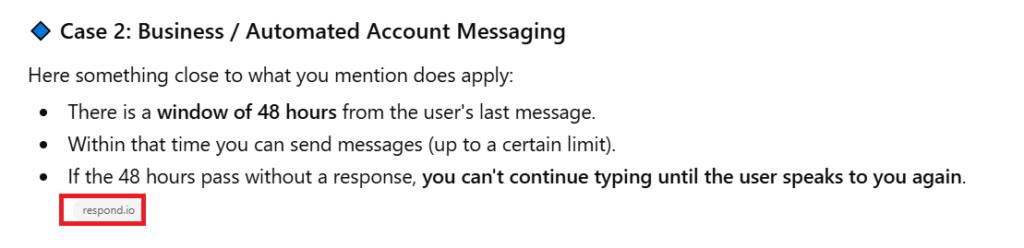
Here we see another problem: the source is respond.io/es/help/tiktok/tiktok-overview, which is an external company (respond.io) that doesn’t belong to TikTok; it’s simply an external CRM that integrates TikTok messages into its platform. The problem is that ChatGPT draws “conclusions” based on this information that can confuse users:
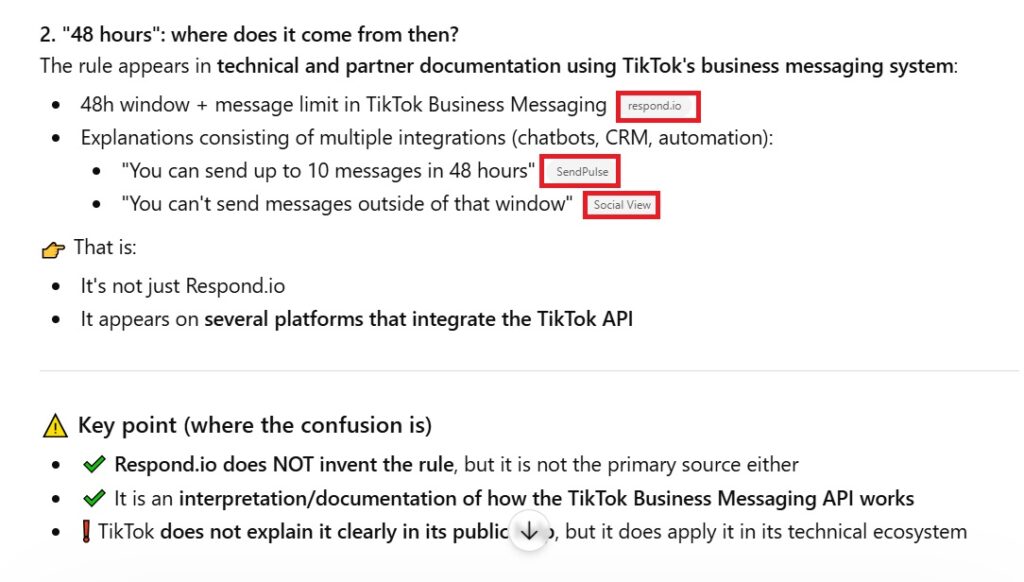
In this case (having reviewed the rules), I asked where this supposed 48-hour rule mentioned by respond.io appears, since it’s not mentioned in TikTok’s rules or public information. In response to this question, ChatGPT stated that this information appears in technical documentation and from partners who use TikTok’s enterprise system, and also mentioned that other websites say the same thing (which lacks support since the fact that several sites publish the same thing doesn’t make it official). However, they began to “clarify” that what these external websites say could be an “interpretation” of the rule.
After noting that these sites aren’t citing official TikTok sources or rules, but are simply explaining how their own CRMs work, and that external sites can “adapt rules for their own system,” the platform finally started issuing warnings about the veracity of this information.
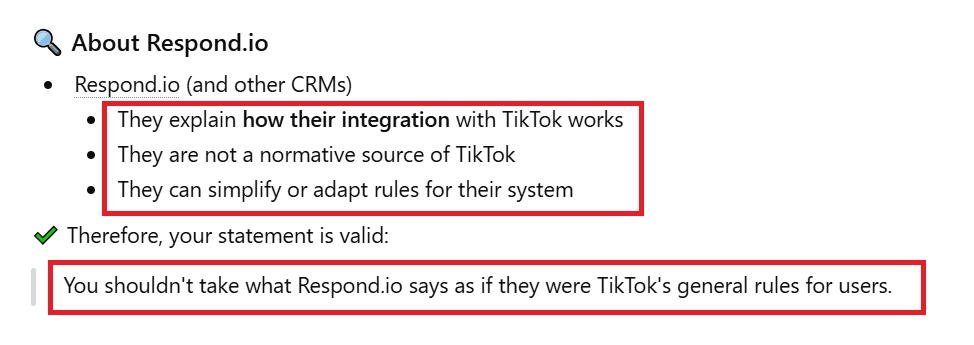
In this example, we can see how ChatGPT (with fairly basic instructions) theoretically “invented” a TikTok rule and responded with little depth or rigor. Because of this, it’s quite dangerous to consult rules or legal topics. We must keep in mind that all AI programs include a disclaimer stating that the platform “may make mistakes and that we should consider verifying important information.”
Other problems when citing sources
It’s important to keep in mind that if a source says “TikTok,” it doesn’t necessarily mean it’s an official source. It could simply be a 5-second video posted on TikTok that mentions the topic (very superficially), as in this example with a question on Grok about the same subject:
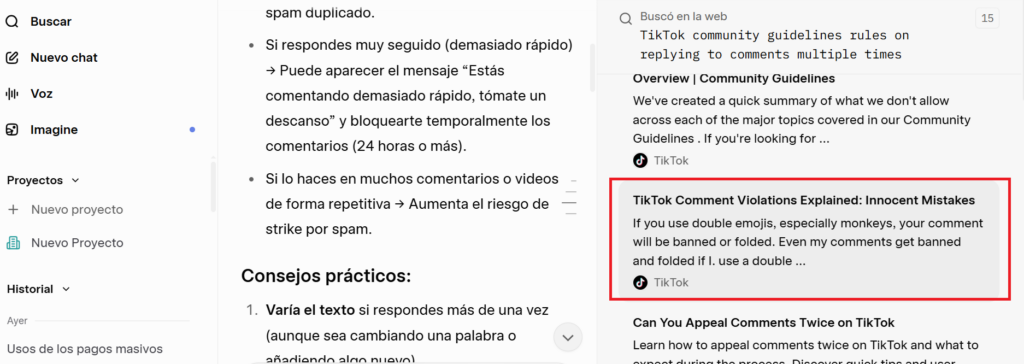
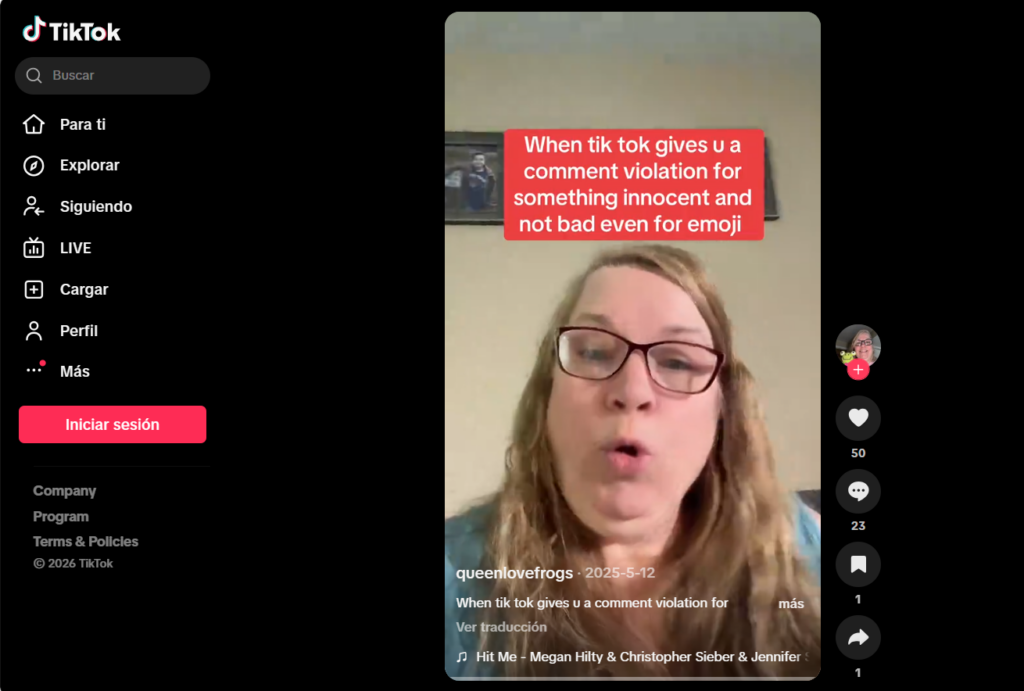
Explanation of why it’s illegal to send more messages if the person hasn’t responded yet
Now we’ll explain why you can’t send a second message on TikTok (if the person hasn’t responded to the previous message), regardless of whether 24, 36, or 48 hours have passed.
First, TikTok’s Community Guidelines, in their “General” section, under “Integrity and Authenticity,” state the following:
Deceptive behavior and fake interactions: We don’t allow accounts that deceive or attempt to manipulate our platform, or exchange services that artificially inflate engagement or deceive the recommendation system.
To explain this rule, if someone asks us a question and we reply, but then the user doesn’t write back, it means they’re no longer interested in continuing the conversation, that our answer wasn’t satisfactory, or for any other reason they deem appropriate. However, if, after some time, for example, the next day (24 hours) or after two days (48 hours), we write back to the user (without them responding), then this behavior can be interpreted as an attempt to manipulate the platform or artificially increase interaction with the user. This second, “additional” message aims to make the user “remember” us or force them to respond so we can continue writing to them.
If this second message is sent within the same conversation (for example, 10 minutes after the last response), it could be considered part of the same conversation. But if this additional message is sent the next day, it’s clear that it’s no longer part of the initial conversation. We must keep in mind that just because someone asks us something doesn’t mean they’re giving us permission to contact them at any time or send multiple messages over time.
Then, in the Integrity and Authenticity section, some examples of things that shouldn’t be done on the platform are mentioned:
–Spam, such as:
Using automation to manage many accounts or sending repetitive content.
This rule also applies to sending a second message (without receiving a previous response), especially if the message is generic or sent to multiple users. The rule also mentions the term spam (unsolicited messages), which can be easily interpreted by the user when they see they’ve been contacted again (even if they didn’t respond to our previous message or decided not to continue interacting).
It’s important to note that spam is also mentioned in another section, Accounts and Features, in the “Comments” section, which states that the following is prohibited:
Spam: random text, irrelevant promotions, or links.
Next, in that same section of accounts and features, under “direct messages,” it mentions what “cannot be done on the platform” (referring to point 3.4 of TikTok’s terms of service), which states:
You cannot do anything deceptive or harmful.
If a conversation is two-way: sender and receiver exchanging messages voluntarily, the moment the other person stops responding means the conversation is over (especially if a day has passed). If we write again, we are “tricking” or “circumventing” the system to circumvent this rule and continue the conversation (even if the user doesn’t want to).
As we can see, many rules apply to this type of activity. In this simple example, we can see how several rules can affect the same action.
Professional Experience on the Topic
In my professional experience, I’ve seen an increase in policy violations as individuals and businesses choose to follow AI program recommendations, especially on TikTok and WhatsApp Business. I believe AI is very useful for many things, but when it comes to rules (especially if they’re very recent), it has significant limitations, which can lead to penalties rather than benefits. We must keep in mind that if we commit an infraction and are penalized by the platform (TikTok or WhatsApp), we can’t say the AI is “to blame” or that we did the action because the AI told us to. Ultimately, we must remember that the representatives of each business or company are responsible, not an AI tool from an external company, whether on TikTok or WhatsApp. Each business is responsible for its own actions.
What are your thoughts on this? Had you heard about this “rule” for responding to TikTok messages? Do you use ChatGPT to check the TikTok or WhatsApp Business rules?
If you need advice on TikTok or WhatsApp Business rules, you can contact me by visiting the following link.
Image by Olivier Bergeron via Unsplash.com under a Creative Commons license.